
Make it Make $ense: Internet Then, Internet Now
 I hear people asking questions about the cost of their internet service. “It’s too high for just Wi-Fi” was a recent social media comment. I get it, no one is happy to pay monthly bills. I’m here to try to make it make sense.
Let’s look back at where we’ve been.
In 2005:
- A new Ford F-150 started at $21,295
- An acre of land in Horry County costs between $2K and $6K depending on location and potential.
- Net Racer internet from HTC was $44.95/month. This was the standard rate after a 6-month introductory rate of $28.95
The download speed of the 2005 internet was barely 1 Mbps download and Wi-Fi was in its infancy. Uploads were in the speed range of dial-up. Most of the time, you went to the wired computer and did what you needed to do on the internet, then were done with it.
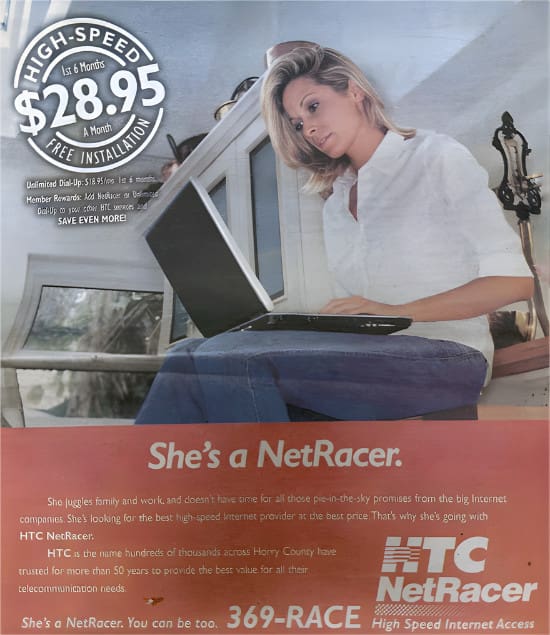 The evolution of internet as a product, and how it is used in our homes is nothing short of extraordinary. Unlike the home utilities like electricity and gas where the consumer pays a metered rate based on usage, the internet providers (universally, not specifically HTC) focused on delivery and how it could be done reliably and faster. The data being transmitted at that time was minimal compared to what it has become. What, in hindsight, seems odd flourished since internet was not a regulated utility. To this day, although it’s often discussed, the internet is still not a regulated utility in the U.S.
Let’s look at our 1 Gig internet service. It is 1000 TIMES FASTER than the barely 1Mbps service we mentioned being delivered in 2005.
Today, your internet needs to power all your devices. Recent data compiled by the FCC shows that the average household had 17-21 connected devices. It’s not just your PCs, your phones, and your TVs. It’s everything from your gaming systems, smart speakers, and wearables to your doorbell and even your thermostat. I left out crock-pot and litter box, but yes, they can run on Wi-Fi too. The bandwidth used is vastly different than it was years earlier. Equipment that automatically delivers 2.4GHz vs. 5GHz to your devices depending on their need and distributes the proper bandwidth without you needing to think about it is a necessity.
If you leave the lights on, the bill goes up. C’mon be honest, did your father ever exclaim in frustration “Do I look like I own the electric company?”
If you leave the water running, or take showers that are too long, the water bill goes up.
Regardless of how much internet you use, you pay a single price.
Internet is a commodity; there are several providers you can buy it from. From Cable companies to cell phone companies everyone has a package for you. Some may be right for you. While you choose between them, here are some of the differences:
- Cable internet is normally run on coaxial copper lines. Even if they say it is ‘Fiber Powered’ it just means that some of the main transport lines are fiber, then it converts to copper to make it to your home. This is known as HFC (Hybrid Fiber-Coaxial) and is lower cost to the provider than bringing fiber right to your home. One key difference with this model is that you don’t normally get upload speeds to match your downloads. (Important in gaming and video uploads)
- Fixed Wireless internet connection is another popular and growing option. Lower cost. Lower speeds (by far) and subject to the congestion of users. In fact, recent data from Q3 2025 shows the big three U.S. carriers experienced fixed wireless speed degradation over the previous two quarters. This is believed to be caused by more people on the network.
As I stated above, where you choose your internet from is up to you. The above are viable options and may work for you. They will have lower introductory rates, and they may charge extra for Wi-Fi and whole home extenders. Data caps and throttling may be a part of the terms and conditions, and they may even say “not compatible with 4K streaming”.
HTC’s fiber internet offers symmetrical speeds; HTC Smart Wi-Fi is included. It is all included in one monthly price.
Beyond that, HTC is local. Local since 1952. We are a cooperative. We are member owned and are a not-for-profit corporation. What does this mean to you? Dollars spent here, stay here. Dollars beyond a reasonable operating profit (needed for network upgrades and disaster/emergencies/hurricane rebuilding) are returned to the community. It is returned in local sponsorships to the schools, the recreation teams and so much more.
There is also the capital credit refund that you, as a member, receive. Every year, those excess dollars get returned to each member through a formula of business year and products billed. You may not see this in your first year or two but ask a neighbor. HTC has refunded over $193 million to Members since 1979! Those dollars don’t go to Wall Street and stockholders; they get returned to you and the community you live in.
I hope it makes more sense now.
